

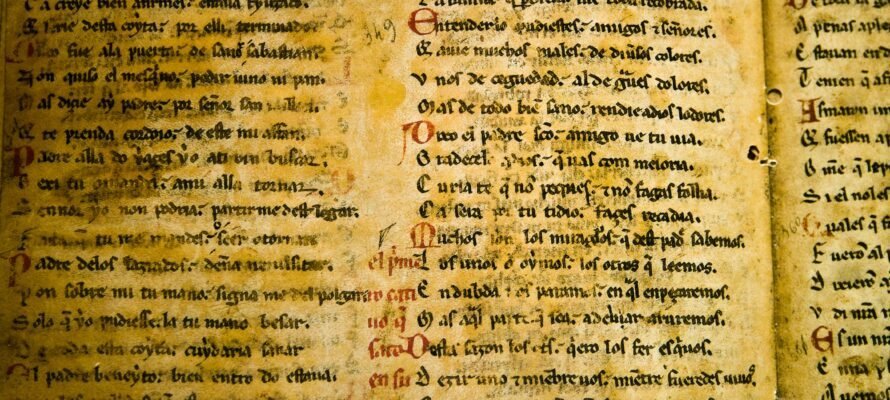
Translation within the same language – the challenge of translation explored through the epic Beowulf
Translation is not always two languages; it may simply be one. As language evolves, we find ourselves needing translation even within the same language. Let’s explore how this phenomenon works in the poem Beowulf.
Traditionally, poetry has been seen as one of the more challenging types of texts to translate. It is scattered with an array of esoteric, often recondite content, intertextuality, idioms, complex grammar, wordplay, and metaphor — a style of text that evokes such emotion that understanding it in Old English is laborious, let alone translating it into another language without inevitably losing so much of the work’s essence.
Beowulf stands as one of the most significant texts in the English literary tradition; it is the oldest surviving epic poem composed in Old English – its manuscript, known as the Nowell Codex, is housed in the British Library, London. While the precise date of its origin remains a matter of scholarly debate, it is generally believed to have been written between 700 and 1,000 AD.
In addition to its antiquity, Beowulf is also amongst the most translated works in the English language. As of 2020, the Beowulf’s Afterlives Bibliographic Database recorded 688 translations and adaptations of the poem across at least 38 languages. This figure is particularly striking given that nearly 300 of these translations are from Old English into various forms of Modern English alone.
Set in pagan Scandinavia, the protagonist Beowulf is tasked with slaying the monster Grendel, who has been terrorizing the King of the Danes, Hrothgar’s mead hall in Heorot for twelve years. Though the story may appear deceptively simple, Beowulf remains one of the most contested and widely discussed texts within the English literary canon, particularly in terms of its translation and interpretation. The main issues arise due to the significant linguistic shift from Old English to Modern English, paired with complex alliteration and a specific metrical structure, making it especially challenging for translators.
Possibly the most famous area of debate begins with the very first word of the epic —“Hwæt.” Scholars such as Francis Barton Gummere and Roy Liuzza have argued that the utterance is a command, a means to interject and obtain the audience’s attention, using translations such as “Listen” or “Lo” (originating from ‘Lo behold’, an archaic interjection from Middle English, used to introduce a new scene or draw attention to an event in a story, often seen as unexpected). This interjection creates a more intense tone, almost as if a warning. However, other scholars have suggested that it is not an interjection, but rather a term of endearment—such as “Oh thou” or even “Bro,” as seen in Maria Dahvana Headley’s 2020 translation. “Oh thou” or “Bro” encapsulates the informal atmosphere of orally sharing stories, whilst producing a more relaxed environment. Thus, from one word alone, the translator’s choice of language sets the epic upon a different path.
An additional domain of contention lies in how one approaches alliterative verse, a form of unrhymed poetry characterized by consistent alliteration and the use of caesura. Alliteration refers to the repetition of the same consonant sound at the beginning of adjacent or closely connected words, while caesura denotes a deliberate pause within a line. For old English verse, caesuras typically divide into two hemistichs (half-lines). Burton Raffel’s 1963 translation of Beowulf offers a compelling example of these techniques: “he moved quickly through the cloudy night, / Up from his swampland, sliding silently / Toward that gold-shining hall.” Here, Raffel employs sibilance—a specific form of alliteration emphasizing the repetition of ‘s’ sounds – a commendable effort considering all of the 3,182 lines were originally written in alliterative verse. Therefore, it is almost impossible to conserve the original meaning paired with replicating the same cadence and caesural breaks due to the linguistic shifts between Old English, (primarily of the West Saxon dialect) and Modern English.
To conclude, Beowulf is a testament to the difficulty and complexity of translation, and a fascinating marker of the English language’s development over time. It continues to be relevant today, with different media adaptations, such as Fantasy flight games´ Beowulf: The Legend board game (2005), Robert Zemeckis´ animated film (2007) or ITV´s Beowulf: Return to the Shieldlands (2016). Thus, Beowulf may never cease to be translated, adapted, and reinterpreted.
See below an example:
Old English (West Saxon dialect)
Hwæt. We Gardena in geardagum,
þeodcyninga, þrym gefrunon,
hu ða æþelingas ellen fremedon.
Oft Scyld Scefing sceaþena þreatum,
monegum mægþum, meodosetla ofteah,
egsode eorlas.
Francis B Gummere Translation
LO, praise of the prowess of people-kings
of spear-armed Danes, in days long sped,
we have heard, and what honor the athelings won!
Oft Scyld the Scefing from squadroned foes,
from many a tribe, the mead-bench tore,
awing the earls
Author: Johnny Ward
Photo by Mark Rasmuson, available on Unsplash