

The changing Capitals of Brazil: what happened, and when?
Since the city was first built in 1960, Brasília has held the esteemed title of capital city of Brazil. However, the country of Brazil has been independent for over two hundred years, and therefore must have had other capital cities before Brasília was even constructed. What cities were they, and why were they chosen?
Salvador
Let’s start at the beginning, shall we? The city of Salvador, situated in the north-east of Brazil and formerly known as Cidade do São Salvador da Bahia de Todos os Santos, was the first ever legitimate capital of Brazil. Of course, this is before Brazil was even a country in its own right, and was existing as a colony of the Portuguese Empire. In 1549, Portuguese settlers led by Tomé de Sousa established the city with its former name. As de Sousa became the first governor-general of the Portuguese colony of Brazil, Salvador was its capital and focal point for slave trade and sugar cane commerce. Over time, the city was split into two halves, with the upper half encompassing religious, residential and administrative activity, and the lower a hub of commerce, equipped with a port and market for trading. As the 16th and 17th centuries passed by, Brazil underwent a great deal of structural changes, including a division into separate governorates of Bahia and Rio de Janeiro, a capturing at the hands of the Dutch West India Company and then a recapturing by a Luso-Spanish army. Nonetheless, Salvador held firm as the core city. That is, until, 1763 rolled around.
Rio de Janeiro
Whilst Salvador remained the centre of agribusiness, the colonial administration was relocated to Rio de Janeiro in an effort to better manage Minas Gerais’ gold mining regions, and in doing so the new capital acquired the title of viceroyalty. Until 1808, the city was simply a colonial capital, but when the Portuguese royal family and its Lisbon nobles relocated to Rio de Janeiro to flee Napoleon’s invasion, the city began to gain more esteem. Then serving as the capital of the entire Portuguese kingdom, Rio de Janeiro became the only European capital outside of the continent of Europe, and the early 19th century bore witness to many exciting developments. The Military Academy, National Library of Brazil and first printed Brazilian newspaper were all established in Rio de Janeiro, firmly asserting the city’s integral position in Brazilian history. When the Portuguese royal family returned to Lisbon in 1821, Rio de Janeiro was no longer Portugal’s capital but remained that of Brazil, which was granted its first independence in the following year, by Prince Pedro. At this moment, Prince Pedro became the founder and first ruler of the Empire of Brazil. Noticing Rio de Janeiro’s strong sugar cane and coffee production, the capital city was kept in its place.
In addition to its commercial pursuits, Rio de Janeiro also functioned as Brazil’s political centre, hosting a fleet of abolitionist and republican movements in the late 19th century, which in turn led to the monarchy’s replacement by republic in 1889. As the Republic progressed, Rio de Janeiro experienced a great deal of expansion and began to gain a reputation for beach party fun, but also favela violence. When Juscelino Kubitschek was elected president in 1955, one of the reasons behind his ascension to power was the promise of relocating the country’s capital. Nonetheless, the first conception of this relocation decision is attributed to José Bonifácio, an advisor to Emperor Pedro I, who presented his idea for a new capital back in 1827. However, when the General Assembly of Brazil was later dissolved, the idea was set aside, at least temporarily. Enter Brasília.
Brasília
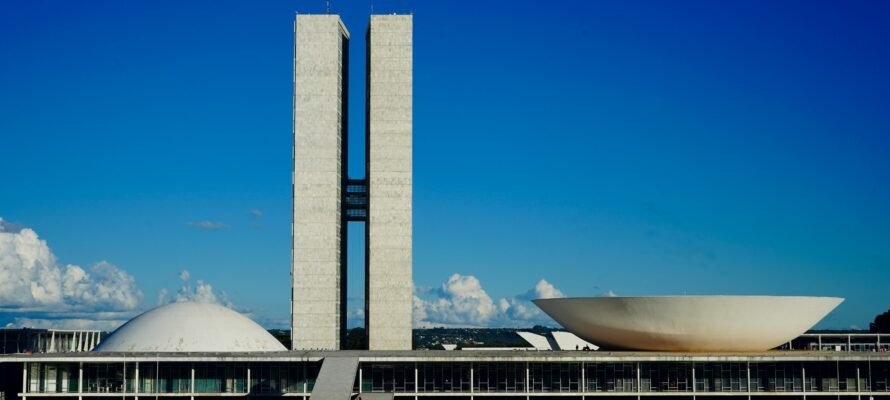
But wait, why did the capital need to change at all? Well, the reasoning was certainly not singular, but indeed reflected a post-colonial belief that having Rio de Janeiro as the seat of power was too constant a reminder of the country’s colonial past. Also, there was a clear desire for the capital city to be located in the centre of the country, as a marker of unity between the entire population, and a more central positioning also meant the capital was less at risk of immediate invasion if a war were to break out. As a coastal city, on the other hand, Rio de Janeiro was an easier target. The entire city of Brasília was constructed from scratch, and therefore despite its modernist architecture greatly bolstering national pride, it also led to a steep increase in inflation and cost of living. Lúcio Costa was selected to lead the new city’s construction, and began planning a city that integrated the upper and middle classes, provided separate housing for the working classes in order to avoid the proliferation of favelas, and prioritised a free-flowing traffic system. Overall, modernity was at the heart of the vision, with the new city spearheading an equally new era for Brazil, and offering it a secure point of pride on the international stage.
So there we have it. A snapshot of Brazil’s capitals over the years. And technically, we did miss one: for a mere three days in 1969, Curitiba was the country’s capital. This move was essentially a power play by the military government of the time, who wanted to demonstrate their presence in one of the most loyal states to the regime. Nonetheless, this brief stint is not usually included in any official lists of Brazilian capitals. As of right now, there are no known plans to move the capital again but, as we know, the future is a fickle thing. Only time will tell.
Author: Lucy Singer
Photo by Anita Monteiro, available on Unsplash